

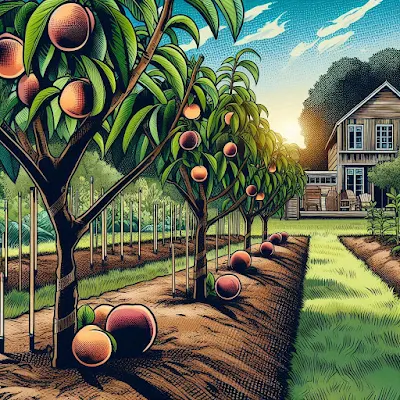
The Art of Fruit Tree Pruning: How to Prune Fruit Trees for Health, Shape, and Better Harvests
There is something deeply satisfying about growing a fruit tree.
You plant a little tree, watch it settle into the garden, and eventually you get the first blossoms. Then come the tiny fruits, followed by the excitement of watching them swell and ripen.
But somewhere along the way, you may find yourself standing beneath that tree with a pair of pruning shears wondering:
"Am I supposed to cut this?"
Fruit tree pruning can look intimidating, especially when you are staring at a tangled collection of branches and trying to figure out which ones should stay.
The good news is that pruning doesn't have to be mysterious.
Once you understand why you're pruning, what you're looking for, and how the tree naturally grows, the process becomes much easier.
Pruning isn't about chopping a tree into submission.
It is about helping the tree grow in a healthier, more useful direction.
Why Prune Fruit Trees?
Fruit trees can often survive without regular pruning, but that doesn't necessarily mean they will grow into productive, manageable trees.
Pruning can help you:
- Remove dead, damaged, or diseased wood
- Improve airflow through the canopy
- Allow more sunlight to reach leaves and developing fruit
- Remove branches that rub against one another
- Control the size and shape of the tree
- Encourage productive new growth
- Improve access for harvesting
- Reduce overcrowding
- Maintain stronger branch structure
- Remove unwanted suckers and water sprouts
- Help keep fruit production within reach
A well-pruned tree isn't necessarily a perfectly symmetrical tree.
The goal is a strong, healthy structure that suits the tree, the growing space, and the gardener.
Before You Make the First Cut
Before grabbing your pruners, spend a few minutes simply looking at the tree.
Walk around it.
Look from different angles.
Notice where the branches are growing.
Look for dead wood, broken limbs, branches that cross, and areas where the canopy is excessively crowded.
Ask yourself:
What am I trying to accomplish?
Are you trying to reduce the size?
Open the canopy?
Remove damaged branches?
Train a young tree?
Improve access to fruit?
Restore an older tree?
Your answer determines how aggressively you should prune.
One of the biggest pruning mistakes is cutting first and thinking afterward.
Take your time.
Know Your Tree Before You Prune It
This is especially important because fruit trees do not all grow or produce fruit in the same way.
Apples, pears, peaches, plums, cherries, citrus, figs, persimmons, and other fruit trees can have very different pruning requirements.
Even two varieties of the same fruit can behave differently.
Before doing major pruning, identify:
- The exact fruit tree or variety, if possible
- Whether it is young, mature, or established
- Whether it fruits on new or older wood
- Its natural growth habit
- Whether it has been grafted
- Your local climate
- The recommended pruning season for your region
This research can save you from accidentally removing the branches that were going to produce next year's fruit.
When Should You Prune Fruit Trees?
There isn't one universal pruning calendar for every fruit tree.
Timing depends on the tree, climate, and reason for pruning.
For many deciduous fruit trees, structural pruning is commonly performed during dormancy. However, some fruit trees and situations call for pruning during the growing season.
Peaches and nectarines, for example, are commonly pruned differently from apples and pears.
Citrus and other evergreen fruit trees also have different considerations.
Young trees may require training cuts, while mature trees may need maintenance pruning.
And an older neglected tree may require several seasons of gradual renovation rather than one dramatic pruning session.
A Simple Rule
Don't prune simply because the calendar says it's "pruning season."
Learn the needs of the particular tree first.
Local climate matters too. A pruning schedule that works beautifully in a cold-winter region may not translate directly to a warm or subtropical climate.
The Basic Fruit Tree Pruning Tools
You don't need a giant collection of gardening tools.
A few good tools will handle most home fruit tree pruning.
Hand Pruners
Use hand pruners for smaller branches and young shoots.
A sharp pair makes cleaner cuts and is easier on both your hands and the tree.
Loppers
Loppers provide more leverage for larger branches that are too thick for ordinary hand pruners.
Pruning Saw
A pruning saw is useful for larger limbs.
Don't try to force a hand pruner onto a branch that is clearly too large for it.
That's how tools get damaged and gardeners get frustrated.
Gloves and Eye Protection
Gloves protect your hands from rough bark, thorns, and sharp branches.
Eye protection is particularly useful when pruning overhead or working around branches that can spring back.
Tool Cleaning Supplies
Keep your pruning tools clean and in good condition.
If you're moving between trees, especially when disease is suspected, cleaning and disinfecting tools can help reduce the possibility of spreading pathogens.
Use an appropriate disinfectant and follow its directions.
The Three Basic Pruning Cuts
Understanding a few basic cuts makes pruning much less intimidating.
1. Remove a Branch Completely
When removing an entire branch, make the cut near the branch collar rather than cutting flush against the trunk.
The branch collar is the slightly swollen area where the branch connects to the trunk or another larger branch.
Don't leave a long stub.
But don't cut into the trunk either.
The goal is a clean cut that allows the tree's natural wound-response processes to work properly.
2. Reduce a Branch
A reduction cut shortens a branch by cutting it back to a suitable lateral branch or bud.
Choose a branch that is large enough to continue the growth you want.
This is useful when you're trying to reduce length or redirect growth.
3. Remove Competing or Unwanted Growth
Some branches simply don't belong in the structure you're trying to create.
This can include:
- Crossing branches
- Rubbing branches
- Inward-growing branches
- Weakly attached branches
- Suckers
- Water sprouts
- Unwanted shoots from below a graft union
Removing these can help reduce crowding and improve the overall structure.
What Should You Prune First?
When you're standing in front of an overgrown fruit tree, don't start by trying to make it beautiful.
Start with the obvious problems.
First: Remove Dead Wood
Dead branches are often the easiest to identify.
They may be brittle, broken, discolored, or completely lacking healthy buds.
Remove dead wood first.
Second: Remove Damaged or Diseased Wood
Broken or visibly diseased branches may need removal.
If disease is suspected, identify the problem before making extensive cuts because different diseases require different management.
Don't automatically assume every discolored branch is diseased.
Third: Remove Suckers
Suckers are vigorous shoots that emerge from the rootstock or lower trunk area.
If they are coming from below the graft union, they should generally be removed because they can compete with the desired tree.
Fourth: Remove Water Sprouts When Appropriate
Water sprouts are fast-growing shoots that often grow vertically from branches or other parts of the canopy.
Some can be removed, particularly when they are poorly positioned or contributing to excessive crowding.
However, don't automatically strip every vigorous shoot from the tree.
The right approach depends on the species, age, training system, and overall structure.
Fifth: Deal With Crossing and Rubbing Branches
Branches that constantly rub against each other can create wounds and increase the potential for future problems.
If two branches are competing for the same space, decide which one has the better position and remove or redirect the other.
Open the Canopy Without Hollowing Out the Tree
One common piece of pruning advice is to "open the center."
That can be helpful for some fruit trees, particularly those trained to an open-center or vase-shaped structure.
But don't assume every fruit tree should have a giant empty hole in the middle.
Different trees use different training systems.
The goal is to create enough space for sunlight and airflow without removing more foliage than necessary.
Over-pruning can be just as problematic as under-pruning.
Central Leader vs. Open Center
Two common training systems you'll encounter are the central leader and open center.
Central Leader
The tree is trained around a dominant central trunk or leader.
This approach is commonly used with apples and pears, although specific varieties and training systems can vary.
Branches are arranged around the central leader to create a balanced structure.
Open Center
The central leader is removed or redirected, creating a more open vase-shaped structure.
This system is commonly associated with peaches and nectarines and is also used with some other stone fruits.
The important thing is to learn which structure works for your particular tree.
Don't force every fruit tree into the same shape.
Think About Sunlight
Fruit trees need leaves to capture sunlight, and developing fruit benefits from good light exposure.
A dense, tangled canopy can create heavily shaded areas.
When pruning, look for opportunities to improve light distribution.
You don't need every branch exposed to direct sunlight all day.
Instead, think about creating a canopy where light can reach productive areas without turning the tree into a skeleton.
Think About Airflow
Good airflow can help foliage dry more quickly after rain and reduce the dense, humid conditions that can favor certain diseases.
If several branches are packed tightly into the same area, selective pruning can create useful breathing room.
This is especially important in humid climates, although disease pressure varies considerably by region.
Don't Over Prune
This deserves its own section because over-pruning is one of the easiest mistakes to make.
When gardeners discover how much better a tree looks after removing a few problem branches, it can be tempting to keep going.
Stop.
A tree needs leaves.
Leaves produce energy through photosynthesis, and removing too much live wood and foliage can stress the tree and trigger vigorous unwanted growth.
If a mature tree needs significant renovation, it is often better to spread major corrective pruning over multiple seasons rather than removing a huge percentage of the canopy at once.
When in doubt, make fewer cuts.
You can always remove more later.
You can't put a branch back.
How Much Should You Remove?
There is no single percentage that applies safely to every fruit tree.
The appropriate amount depends on:
- Species
- Age
- Health
- Size
- Previous pruning
- Growing conditions
- Training system
- Reason for pruning
For a healthy established tree, conservative pruning is usually a better starting point than aggressive removal.
Young trees may require more intentional training, while neglected mature trees often benefit from gradual correction.
Pruning Young Fruit Trees
Young trees are an opportunity to establish good structure before problems become complicated.
Instead of waiting until the tree becomes a tangled mess, guide it early.
Look for:
- Strong branch spacing
- Good branch angles
- A balanced structure
- A suitable leader or scaffold arrangement
- Branches that aren't competing heavily with one another
Training a young tree can save years of corrective pruning later.
And remember, a young fruit tree may look disappointingly bare after proper structural pruning.
That's okay.
You're building the framework for the future.
Pruning Mature Fruit Trees
Mature trees require a little more restraint.
Start by identifying the biggest structural problems.
You may need to remove:
- Dead limbs
- Broken branches
- Diseased wood
- Crossing branches
- Weakly attached growth
- Excessive water sprouts
- Branches blocking access
- Unproductive or poorly positioned growth
Don't try to completely redesign an old tree in one afternoon.
Older trees have history.
Work with the structure that already exists rather than fighting it.
What About Neglected Fruit Trees?
If you've inherited an old fruit tree that hasn't been pruned in years, don't panic.
You don't have to fix everything at once.
Start with the obvious hazards and dead or damaged wood.
Then gradually improve the structure over time.
A neglected tree may require several pruning sessions across multiple seasons.
This approach gives you time to observe how the tree responds and reduces the stress associated with aggressive renovation.
Pruning Fruit Trees for Better Harvests
Pruning can improve fruit production, but more pruning does not automatically mean more fruit.
The relationship between pruning and fruiting is complicated.
Some trees produce fruit on new growth.
Others produce fruit on older spurs or branches.
Some varieties naturally produce heavy crops and may require thinning of fruit later in the season.
Pruning should therefore be based on how your specific tree produces fruit.
Remember:
Pruning creates the structure.
Fruit thinning manages the crop.
They are related, but they are not the same job.
Don't Forget Fruit Thinning
If your fruit tree produces a heavy crop, thinning young fruit can sometimes improve the size and quality of the remaining fruit and reduce excessive strain on branches.
This is especially relevant for certain tree fruits such as apples, peaches, and plums.
Follow species-specific guidance because thinning timing and recommended spacing vary.
A tree covered in tiny fruits may look exciting, but allowing every fruit to develop can result in smaller fruit, broken branches, or excessive stress.
Sometimes the best harvest comes from growing fewer fruits better.
Common Fruit Tree Pruning Mistakes
Mistake #1: Pruning Without Identifying the Tree
Don't assume every fruit tree should be pruned the same way.
Mistake #2: Cutting Everything Straight Across
Where and how you make the cut matters.
Mistake #3: Leaving Long Stubs
Long stubs can interfere with proper healing and create opportunities for decay.
Mistake #4: Cutting Flush Against the Trunk
Avoid cutting into the branch collar.
Mistake #5: Removing Too Much
More pruning isn't automatically better.
Mistake #6: Ignoring the Graft Union
Remove unwanted shoots that originate below the graft when appropriate.
Mistake #7: Pruning Only for Appearance
A pretty tree isn't necessarily a productive tree.
Think about structure, health, light, airflow, and fruiting habits.
Mistake #8: Using Dull or Damaged Tools
Sharp tools make cleaner cuts and are easier to control.
Mistake #9: Making Huge Renovation Cuts Without a Plan
Large branches should be removed carefully and safely.
If a limb is large, high, unstable, or near structures or utility lines, hire a qualified professional rather than attempting it yourself.
A Simple Pruning Checklist
Before you start:
1. Identify the tree.
Know what you're working with.
2. Check the recommended pruning season.
Consider your local climate as well as the species.
3. Inspect the entire tree.
Walk around it before making any cuts.
4. Remove obvious dead and damaged wood.
Start with the easiest decisions.
5. Look for crossing and rubbing branches.
Choose which growth should remain.
6. Check for suckers and unwanted vertical shoots.
Remove growth that doesn't fit the tree's structure when appropriate.
7. Look at the canopy.
Ask whether additional selective pruning would improve light and airflow.
8. Step back frequently.
Don't prune with your face six inches from the branch.
Walk away and look at the whole tree.
9. Stop before you've gone too far.
A little restraint is a wonderful pruning skill.
A Few Extra Fruit Tree Pruning Tips
Take Before-and-After Photos
This sounds silly until you're trying to remember what the tree looked like six months ago.
Photos help you track growth and see how the tree responds to pruning.
Keep Notes
Write down:
- Pruning date
- Tree variety
- Major branches removed
- Weather conditions
- Fruit production
- Problems noticed
Over several seasons, these notes can become your own personalized fruit tree guide.
Learn the Buds
As you become more comfortable pruning, start paying attention to buds.
Bud position can help you understand where future growth may develop.
Different fruit trees also have different types of fruiting wood, so learning what your tree's flower and fruit buds look like can make pruning much more intentional.
Don't Rush
Pruning is easier when you aren't trying to finish the entire orchard before lunch.
Take your time.
Make a few cuts.
Step back.
Look again.
Then decide.
What to Do With the Branches You Remove
Don't automatically throw every branch into the trash.
Depending on your local rules and the condition of the wood, pruned branches may have other uses.
Small healthy branches can sometimes be chipped for mulch or composted appropriately.
Straight, useful pieces may become garden stakes or kindling where permitted and suitable.
Diseased plant material should be handled according to local recommendations rather than casually adding it to a compost pile.
And if you're dealing with thorny branches, wear gloves.
Your future self will appreciate it.
The Art Is Knowing When to Stop
Good pruning isn't about creating a perfectly shaped tree.
It is about learning to see the tree underneath all the extra growth.
You begin to notice which branches are strong.
Which ones are competing.
Where sunlight enters the canopy.
Where air gets trapped.
Where fruit is likely to develop.
Where the tree is carrying unnecessary weight.
Eventually, pruning becomes less about following a list of cuts and more about understanding what the tree is telling you.
That's the art.
Fruit tree pruning can seem intimidating when you're looking at a mature tree covered in branches.
But you don't have to become an expert overnight.
Start by learning one tree at a time.
Understand how it grows.
Learn when it fruits.
Watch where it sends new growth.
Practice identifying dead, damaged, crossing, and poorly positioned branches.
Make thoughtful cuts rather than dozens of impulsive ones.
And remember:
You don't have to prune perfectly to become a better gardener.
Every season gives you another opportunity to observe, learn, and improve.
Before long, you'll look at a fruit tree and see more than branches.
You'll see its structure, its potential, and the next season of fruit waiting to happen. 🌿🍎
Practical Gardening Note
Fruit tree pruning varies significantly by species, variety, age, rootstock, climate, disease pressure, and training system. Recommended pruning times and techniques for a tree growing in a cold northern climate may be very different from those appropriate for a warm, humid, subtropical, or tropical region. Always check regionally appropriate guidance for your specific fruit tree before major pruning. If a tree has large hazardous limbs, is near power lines or structures, or requires extensive structural work, consult a qualified arborist.


